 Visit Arabia
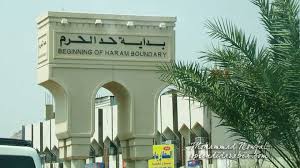
The Haram (الحرم) is the sacred territory surrounding Makkah, whose limits were fixed by Ibrahim عليه السلام on the order of Allah, and confirmed by the Prophet ﷺ.
In this sacred space, certain actions are forbidden: cutting trees, hunting animals, fighting (except in self-defence), entering without the state of Ihram for Hajj/Umrah (according to the schools).
Sahih al-Bukhari no. 1834 · Sahih Muslim no. 1353
The Haram extends over about 550 km² around the Kaaba, with markers (Anṣāb al-Ḥaram) set all around: North (At-Tan'im) at 7 km, South (Adat Libn) at 12 km, East (Ji'ranah) at 22 km, West (Ash-Shumaysi) at 22 km, North-east (Nakhla) at 14 km.
On the day of the conquest of Makkah, the Prophet ﷺ declared:
> "Allah made Makkah sacred on the day He created the heavens and the earth. It is sacred by the sanctification of Allah until the Day of Resurrection. It was not permitted to anyone before me to fight in it, nor to me except for one hour of one day [the day of the conquest]. Its thorny plants are not to be cut, its game is not to be hunted, its lost property is not to be picked up except to announce it, and its green grass is not to be uprooted."
Sahih al-Bukhari no. 1834 · Sahih Muslim no. 1353
Pilgrims coming from outside enter Ihram at their miqat, before arriving. It is here, at at-Tan'im (Masjid 'Aisha), the point of the Haram closest to the Sacred Mosque, that people already present in Makkah leave the Haram to enter Ihram for an Umrah, as 'Aisha رضي الله عنها did on the order of the Prophet ﷺ.
The Saudi authorities have clearly marked the limits with green signs reading "Boundary of Haram", gateways on the main highways, and symbolic walls in certain places.