 Visit Arabia
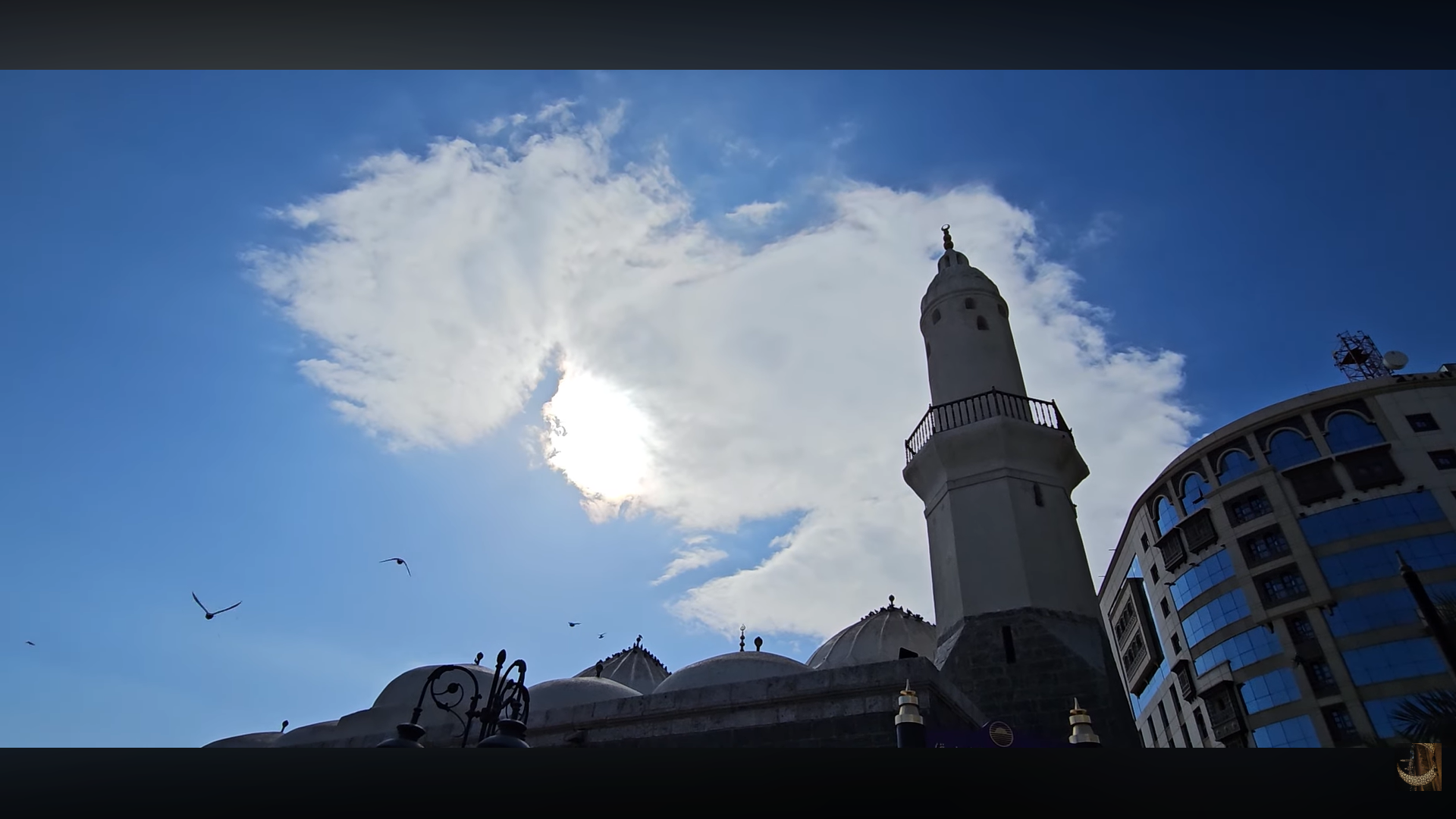
MOSQUE OF AL-GHAMAMA (THE CLOUD)
The Mosque of the Cloud.
The Miracle of Rain
In Medina, there is a mosque with an astonishing name: Masjid al-Ghamama — the Mosque of the Cloud. This name is traditionally linked to the prayer for rain (istisqa'): the Prophet ﷺ would go out to the Musalla to ask for rain (Sahih al-Bukhari no. 1012). The most famous authentic account of the cloud, however, took place during a Friday sermon, in his mosque (Sahih al-Bukhari no. 1013).
Medina sometimes experiences droughts. One day, a Bedouin stood up during the Friday sermon and said: "O Messenger of Allah! The crops have perished, the children are hungry. Ask Allah to send us rain."
The Prophet ﷺ raised his hands and invoked three times: "O Allah, send us rain." And immediately, while the sky was perfectly blue, a cloud appeared.
Anas ibn Malik (رضي الله عنه) reports: "By Allah, I saw no cloud in the sky. And a cloud appeared from behind the mountain, like a shield. And when it was in the middle of the sky, it spread out, and then the rain began to fall." (Sahih al-Bukhari no. 1013 · Sahih Muslim no. 897)
The Rain That Did Not Stop
The rain fell for six days and six nights without interruption. Medina was flooded. The following Friday, the Prophet ﷺ was asked to stop the rain. He smiled and invoked: "O Allah, around us but not upon us. O Allah, upon the hills, the mountains, the valleys."
And Anas (رضي الله عنه) reports: "The rain stopped, and we went out to walk in the sun." (Sahih al-Bukhari no. 1013)
Why the Name
Al-Ghamama means in Arabic "the cloud" — more specifically, a cloud that brings rain. According to tradition, it is here that the Prophet ﷺ performed the prayer of Eid al-Fitr and Eid al-Adha.
The Mosque of Eid
"The Messenger of Allah ﷺ, during the two Eids, would go out to the Musalla (open-air prayer place)." (Sahih al-Bukhari no. 956)
These five mosques (Al-Ghamama + Abu Bakr + Umar + Uthman + Ali) together form "the complex of the Eid mosques" — the Musalla of the Prophet ﷺ.
Architecture
The Mosque of Al-Ghamama was built under the caliph Umar ibn Abd al-Aziz, restored by the Mamluk sultan an-Nasir Hasan ibn Muhammad ibn Qalawun, then rebuilt under the Ottoman sultan Abdülmecid I (1859), who gave it roughly its current appearance, before Saudi renovations. It features 6 characteristic domes, 1 central minaret, a capacity of ~600 worshippers, located about 500 meters west of the Bab as-Salam gate of the Prophet's Mosque ﷺ.